· 11 min read
SaaS Privacy Policy: Write One From Your Real Stack
How to write a SaaS privacy policy from the tools you use: which vendor triggers which disclosure, GDPR and CCPA sections, transfers and clause excerpts.



Short answer: a SaaS Privacy Policy has to name the services that handle your users' data, say what each one does with it and where, and give the legal basis, rights and contact details that GDPR and CCPA/CPRA ask for. Start from your actual stack, turn each vendor into a disclosure, then have a qualified lawyer review the draft before you publish.
Why a SaaS Privacy Policy can't be a generic template
Most founders need a policy before launch for a practical reason. Stripe, Google sign-in and ad products all require a published privacy policy.
The law points the same way. CalOPPA (Business and Professions Code §22575(a)) requires any commercial website or online service that collects personally identifiable information from California residents to post a privacy policy conspicuously. There is no revenue threshold. The CCPA does have applicability thresholds, so check the current figures against your business.
GDPR Article 13 asks for the "recipients or categories of recipients" of personal data. Processors count as recipients, according to gdpr-text.com. Your vendor list is required content.
Platforms check too. Google's OAuth review rejects template or sample policies.
A template also misses your dual role. A SaaS company is usually a controller for account, billing, security and marketing data, and a processor for content its customers upload, as wolja.digital and compliancestack.ai explain. One document cannot do both jobs. Step 2 covers the split.
This post is general information, not legal advice.
1. List your stack before you write a word
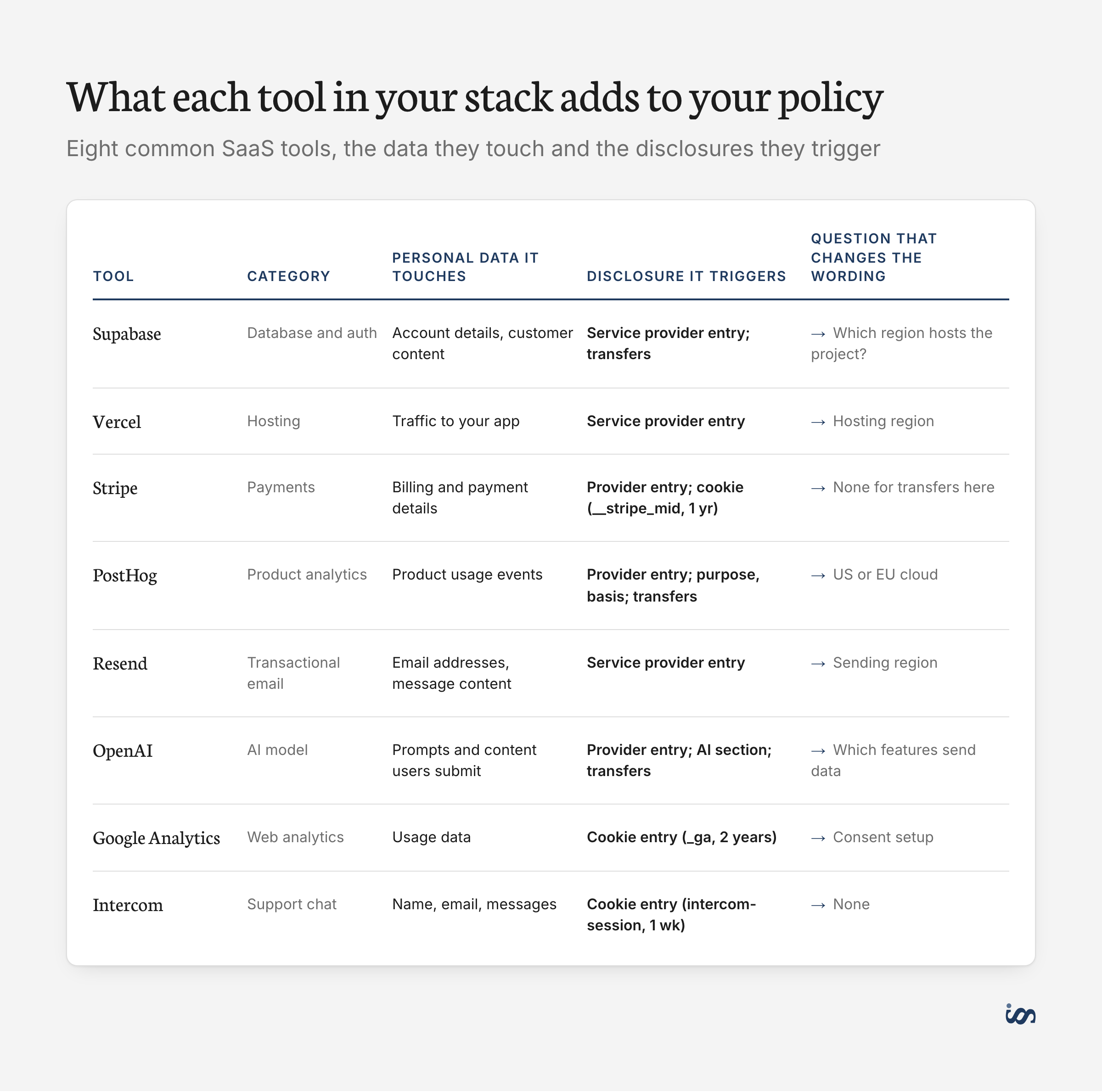
Each tool that touches personal data is a recipient you have to disclose. So start with an inventory, not a template. nextrey.com is the only ranking page that says to map the product first.
Group your tools by category: hosting and database, payments, analytics, email, error tracking, support and AI models. For each tool, write down four things:
- What it does.
- What personal data it touches.
- Where it processes data.
- Whether it sets cookies.
This post uses one example stack throughout: Supabase, Vercel, Stripe, PostHog, Resend and OpenAI. Google Analytics and Intercom join for the cookie examples.
Vendors change their terms, regions and cookies. Check each vendor's current privacy policy and DPA before you rely on a row.
2. Separate the data you control from the data your customers upload
Your Privacy Policy covers the data you decide how to use. That is controller data: sign-up details, billing, security logs, marketing-site analytics and support conversations.
It does not cover the files, records and messages your business customers put into the product. For that content you are a processor. GDPR Article 28(3) requires a written contract between controller and processor, which is the Data Processing Agreement (DPA).
Article 28(2) adds a rule on vendors. A processor cannot use a sub-processor without the controller's prior written authorisation. SaaS companies usually handle this with a general authorisation plus a public subprocessor list. For more, see the DPA and Subprocessor list that cover customer content.
The Privacy Policy should say two things about customer content:
- The customer is the controller of it.
- End users should send their requests to that customer.
Have a lawyer review how your draft words this hand-off.
California has a parallel. Service providers and contractors don't have to answer access requests directly for data they hold in that role.
3. Map each section to the rule that requires it
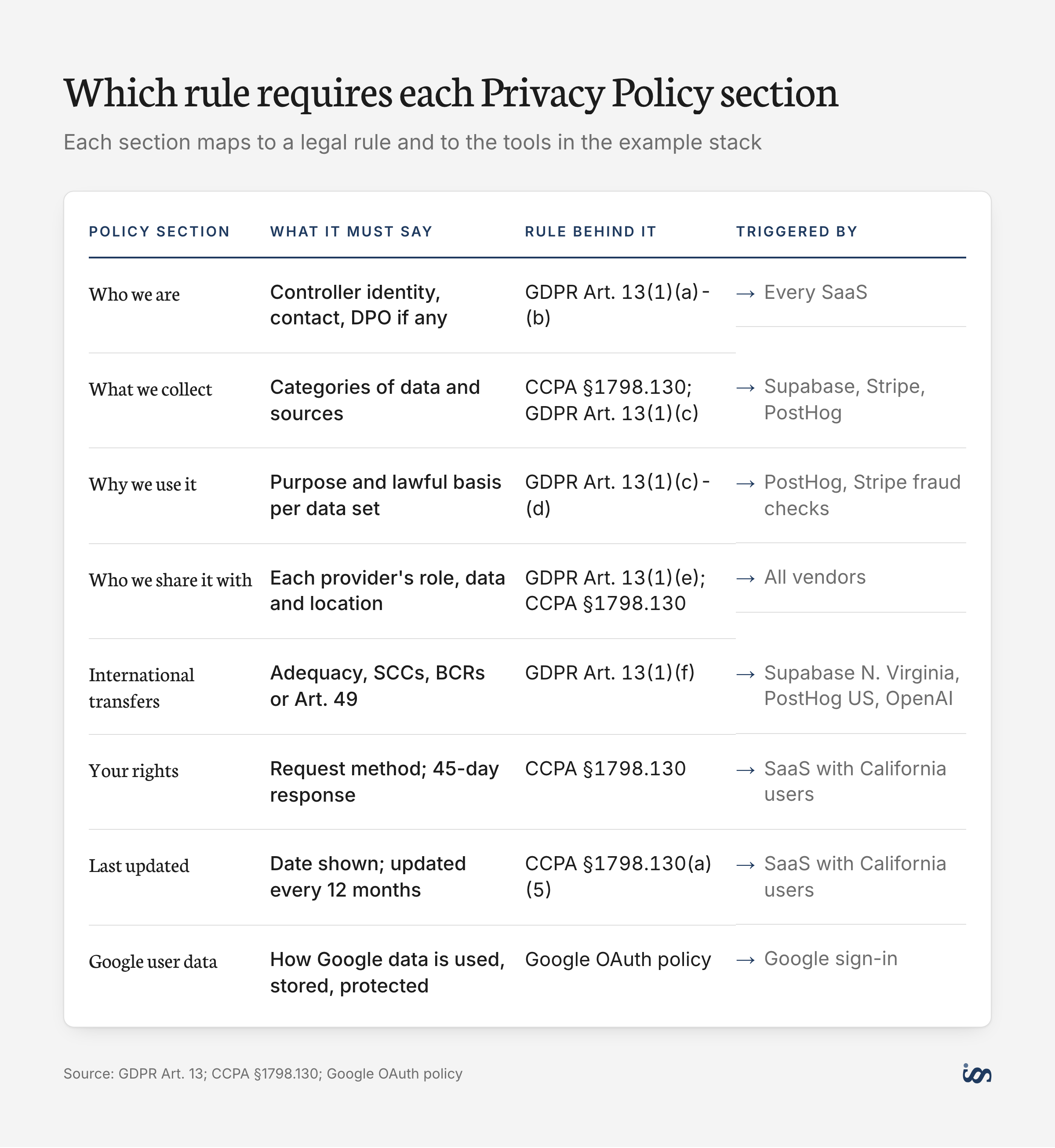
Every heading in your policy should exist because a rule asks for it. Under GDPR Article 13, you give the information "at the time when personal data are obtained". That includes:
- Your identity and contact details, and a DPO contact where one applies.
- The purposes and legal basis for each use.
- Any legitimate interests you rely on under Article 6(1)(f).
- The recipients of the data.
Consent is only one of six lawful bases. CookieYes gives analytics and fraud prevention as common legitimate-interest examples. State the basis for each purpose.
California adds its own list. A CCPA/CPRA policy covers the categories of personal information collected, their sources, the business or commercial purposes, and the categories of third parties the information is disclosed or sold to, according to OpenAgreements. The CPRA also added sensitive personal information.
The wording must be "concise, easily accessible and easy to understand", in plain language, according to the Irish Data Protection Commission.
If you serve UK users, UK GDPR Article 13 refers to adequacy regulations under s.17A of the Data Protection Act 2018. TermsFeed notes that lawful-basis and transfer clauses are UK GDPR obligations that US law does not require.
4. Write the service provider section vendor by vendor
"We share your data with third parties" tells a reader nothing, and it does not name the recipients Article 13 asks for. Ranking pages rarely go further. Michalsons offers a single sample sentence: "We share your credit card information with third-party payment processors…". freeprivacypolicy.com relies on dated screenshots, such as Skubana and "G Suite".
A useful entry has six parts:
- The vendor's legal entity.
- Its role.
- The data categories it receives.
- The purpose.
- The location.
- A link to the vendor's privacy policy.
For Stripe, that means the legal entity named in Stripe's current documents, a payments purpose, billing and payment data, its location and a link to Stripe's privacy policy. Write the same kind of entry for Supabase, Vercel, PostHog, Resend and OpenAI.
This is where a tool library helps. Each of the 68 tools in the Instant Terms library comes with its own clauses, data categories and cookies, plus links to the vendor's privacy policy and DPA. The output is a first draft for a qualified lawyer to review before you publish.
Vendor legal entities and policies change. Check current versions before you publish.
5. Get international transfers right: Supabase in N. Virginia vs Frankfurt
Under GDPR Article 13, the policy should name the transfer mechanism you rely on. The options are an adequacy decision (Art. 45), binding corporate rules (Art. 47), standard contractual clauses (Art. 46(2)) or Art. 49 derogations.
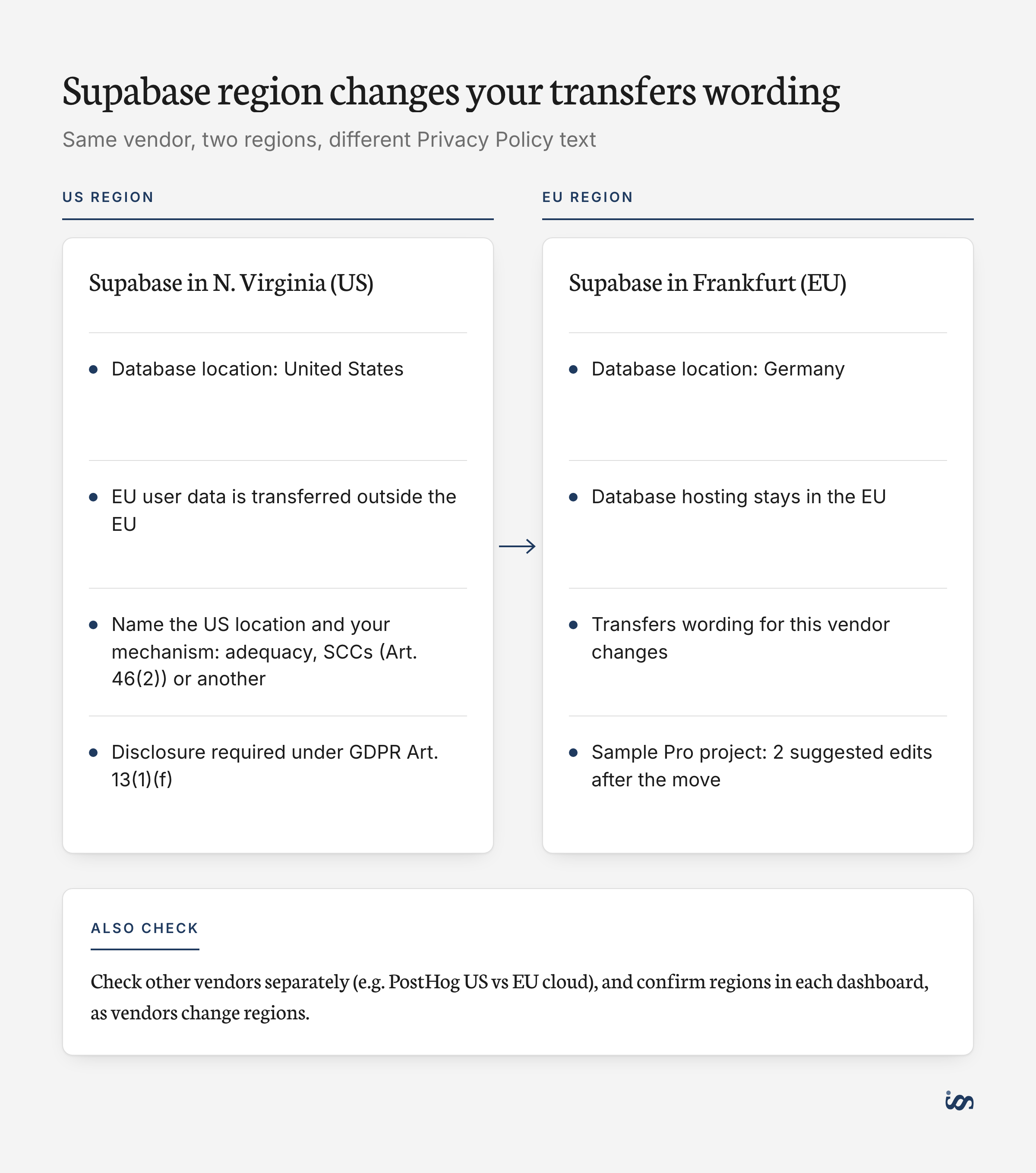
One region answer changes the text. Take Supabase:
- N. Virginia (US). EU user data leaves the EU. The transfers section names the US location and the mechanism you rely on.
- Frankfurt (EU). The database is hosted in the EU, so the transfers wording for that vendor changes.
In the labelled Instant Terms sample Pro project, moving Supabase to Frankfurt produced 2 suggested edits. PostHog follows the same pattern, with a US cloud and an EU cloud. For the full wording, see Supabase Privacy Policy wording for N. Virginia and Frankfurt.
In Instant Terms, a per-tool question about which region hosts your Supabase project or PostHog Cloud sets this wording.
Confirm your real project region in the vendor dashboard, and check the vendor's current list of regions.
6. Add the sections your features trigger: cookies and AI
Your features, not your company size, decide which extra sections you need. Cookies and AI are two common examples.
Cookies. The Privacy Policy points to a Cookie Policy that lists real cookie names with purpose, category and duration. Google Analytics sets _ga for 2 years, Stripe sets __stripe_mid for 1 year, and Intercom sets intercom-session for 1 week. Compare your own site against the cookies a typical SaaS stack sets.
AI. If user content goes to OpenAI or another model provider, say so. Name the provider and its location, and state what is sent. Among the ranking pages, only nextrey.com mentions "AI APIs".
In the labelled sample Pro project, adding OpenAI produced 5 suggested edits. One AI vendor touches several parts of a policy.
Do not write claims about training or retention from memory. Check the provider's current API terms and describe what they say. For the wider picture, read what the legal pages of an AI SaaS need to say.
7. If you use Google sign-in, write for OAuth review
Google's OAuth verification rules are a real cause of rejection for web apps, and none of the ranking SaaS-policy pages covers them.
Three rules matter:
- Template or sample policies are rejected.
- The policy must sit in the body of a dedicated web page, not an embedded PDF or iframe, and should be on the same domain as the app homepage.
- It must disclose how the app "accesses, uses, stores, or shares" Google user data, and how that data is protected.
Add a Google user data section to the policy and publish it as an HTML page.
8. Check your draft against the mistakes top results repeat
Several ranking pages repeat errors. Check your draft for these.
- "Consent is always required." PayPro Global's answer page says SaaS providers must gain express and informed consent before collecting data. Consent is one of six lawful bases. Account data often relies on contract, and analytics or fraud prevention on legitimate interests. Cookies are handled in the Cookie Policy.
- "A toll-free number is mandatory." The default under the CCPA text is two or more request methods, including a toll-free number. A business that operates only online and has a direct relationship with the consumer only needs to provide an email address. GoAdopt's checklist gets this wrong for online-only SaaS.
- "Every SaaS that collects data falls under the CCPA." PayPro Global's page says this too. The CCPA has applicability thresholds. CalOPPA has no revenue threshold.
- "HIPAA sits beside GDPR and CCPA as a general user-rights law." The same page lists it that way. HIPAA is a different kind of law and does not belong on a general list.
Then check three basics: tools you use but have not disclosed, a missing transfer mechanism and no last-updated date.
The free policy checker looks for these gaps. Upload your current policy as a PDF, Word file or pasted text and pick your tools. You get a score and a list of what is missing, from undisclosed tools to GDPR and CCPA requirements. You get 3 free checks a month with an account.
9. Publish it, date it and link it where people look
A policy only helps if people can find it. autocompliances.com advises three places: the site footer, the sign-up form and the app settings. The same source notes that B2B customers often require a compliant privacy policy as a contractual prerequisite.
Publish it as an HTML page on your own domain. Google's OAuth rules ask for exactly that.
Show the last-updated date. Under CCPA §1798.130(a)(5), the policy must be updated at least once every 12 months.
Plan for verifiable CCPA requests. You respond within 45 days, covering the preceding 12 months.
Link the Privacy Policy, Cookie Policy and Terms of Use to each other, so a reader on one can reach the others.
10. Keep it in step with your stack
The 12-month rule is a minimum. A new vendor changes your recipients, and sometimes your transfers and cookies, on the day you add it. That means updating the Privacy Policy and the Subprocessor list, and notifying customers as your DPA requires.
In the labelled sample Pro project, adding Meta Pixel produced 6 suggested edits.
On Pro, adding a tool or moving a region produces suggested edits as tracked changes that keep your own edits. You also get effective dates, drafted emails to users and a changelog. Instant Terms does not claim to update documents for changes in the law.
For the process, read keeping your Privacy Policy in sync with your tech stack.
Check your current policy, then draft from your stack
If you already have a policy, check it first. The free checker gives you a score and a list of missing items, with 3 checks a month on an account.
If you don't have a policy, you can draft a SaaS Privacy Policy from your real stack. Drafting and previewing are free with no card required, and the site says drafting takes about five minutes. The One-off set is $24 once per project for the Privacy Policy, Terms of Use and Cookie Policy. Pro is $11 a month and adds updates as your stack changes.
Instant Terms produces first drafts. It is not a law firm, and it recommends that a qualified lawyer reviews your documents before you publish them. It does not guarantee compliance with any law.
FAQ
Is a privacy policy legally required for a SaaS company?
In practice, yes. CalOPPA requires one for any commercial site or online service that collects personally identifiable information from California residents, with no revenue threshold. GDPR Article 13 requires the information whenever you collect data from EU users. Stripe, Google sign-in and ad products also require a published policy.
Do I need users' consent to collect data in my SaaS?
Not always. Consent is one of six GDPR lawful bases. Account data often relies on contract, and analytics or fraud prevention often on legitimate interests, which you then state in the policy under Article 13(1)(d). Cookies are handled separately in the Cookie Policy.
Is a SaaS company a data controller or a data processor?
Usually both. You are a controller for account, billing, security and marketing data, and a processor for content your customers upload. The Privacy Policy covers the first. A DPA and Subprocessor list cover the second.
Do I need a DPA as well as a Privacy Policy?
If you process personal data on behalf of business customers, GDPR Article 28(3) requires a written contract between controller and processor, which is the DPA. The Privacy Policy speaks to individuals. The DPA is a contract with your customer. See the DPA and Subprocessor list that cover customer content.
How often should I update my SaaS Privacy Policy?
At least once every 12 months, with a visible last-updated date, under CCPA §1798.130(a)(5). Also update it whenever you add or change a vendor or move a data region, because the recipients and transfers sections will change.
Can one Privacy Policy cover both B2B and B2C users?
One policy can cover the personal data you control for all users. Content that business customers upload is processed on their behalf and belongs under the DPA, so the policy should point those end users to the customer. Have a lawyer review how your draft handles both.
Why was my web app's privacy policy rejected by Google?
Common reasons are that it is a template, that it is a PDF or iframe rather than an HTML page, or that it is not on the same domain as the app homepage. Google also rejects policies that don't explain how the app accesses, uses, stores, shares and protects Google user data.
A policy is only as accurate as the inventory behind it. Keep the list from step 1 next to your codebase, and when the list changes, the policy changes with it.
Drafts, not legal advice
Instant Terms is not a law firm and does not give legal advice. Everything it produces is a first draft based on your answers, and it may not cover every law or situation that applies to your product. We always recommend having a qualified lawyer review your documents before you publish them. You are responsible for the documents you use.